Tank vs. Tankless Water Heaters: Which One Is Best for Your Home?


Key Takeaways
- Tank water heaters store 40 to 80 gallons of hot water and lose energy through standby heat loss, while tankless water heaters heat water only on demand.
- The U.S. Department of Energy estimates tankless water heaters are 24% to 34% more efficient for homes using 41 gallons or less of hot water per day.
- Tankless efficiency gains drop to 8% to 14% in high-demand homes using around 86 gallons per day.
- Tank water heaters cost less to install, while tankless systems may need gas line, venting, or electrical upgrades.
- Tank water heaters typically last 10 to 15 years, and tankless units often last 20 years or more.
- Most tankless units deliver 2 to 5 gallons per minute, which can limit simultaneous use in larger households.
The tank vs tankless decision comes down to how much hot water your household uses, how much space you have, and how long you plan to stay in your home. A traditional tank water heater stores and reheats 40 to 80 gallons around the clock, while a tankless water heater heats water only when you open a tap. Since 1993, Air Control Heating and Air has helped North Atlanta homeowners make this choice.
How Do Tank and Tankless Water Heaters Work?
A tank water heater keeps a reservoir of water hot at all times, while a tankless water heater heats water instantly as it flows through the unit. A conventional tank uses a gas burner or electric elements to hold stored water near your set temperature, usually around 120°F. That stored water slowly loses heat through the tank walls (called standby heat loss), so the tank reheats again and again, even overnight.
A tankless water heater (also called an on-demand water heater) has no storage at all. When you turn on a hot tap, water passes through a powerful burner or heating element and comes out hot within seconds. The trade-off is flow rate: the U.S. Department of Energy (DOE) notes most tankless units deliver 2 to 5 gallons per minute, with gas models outperforming electric ones.
Which Water Heater Costs Less: Tank or Tankless?
A tankless water heater usually costs less to run each month, while a tank water heater costs less to buy and install. The DOE estimates tankless units are 24% to 34% more efficient than storage tanks for homes using 41 gallons of hot water or less per day, and 8% to 14% more efficient for homes using around 86 gallons per day.
Upfront water heater cost runs the other way. Switching to tankless often requires a larger gas line, new venting, or an electrical upgrade, so installation costs more than a like-for-like tank swap. Over time, a high-efficiency water heater earns back that difference through lower energy bills. We’ll walk through the real numbers for your home so you never pay for more system than you need.
How Do Tank and Tankless Water Heaters Compare on Space, Lifespan, and Maintenance?
A tankless water heater takes up far less space and typically lasts longer than a tank, but both systems need yearly maintenance.
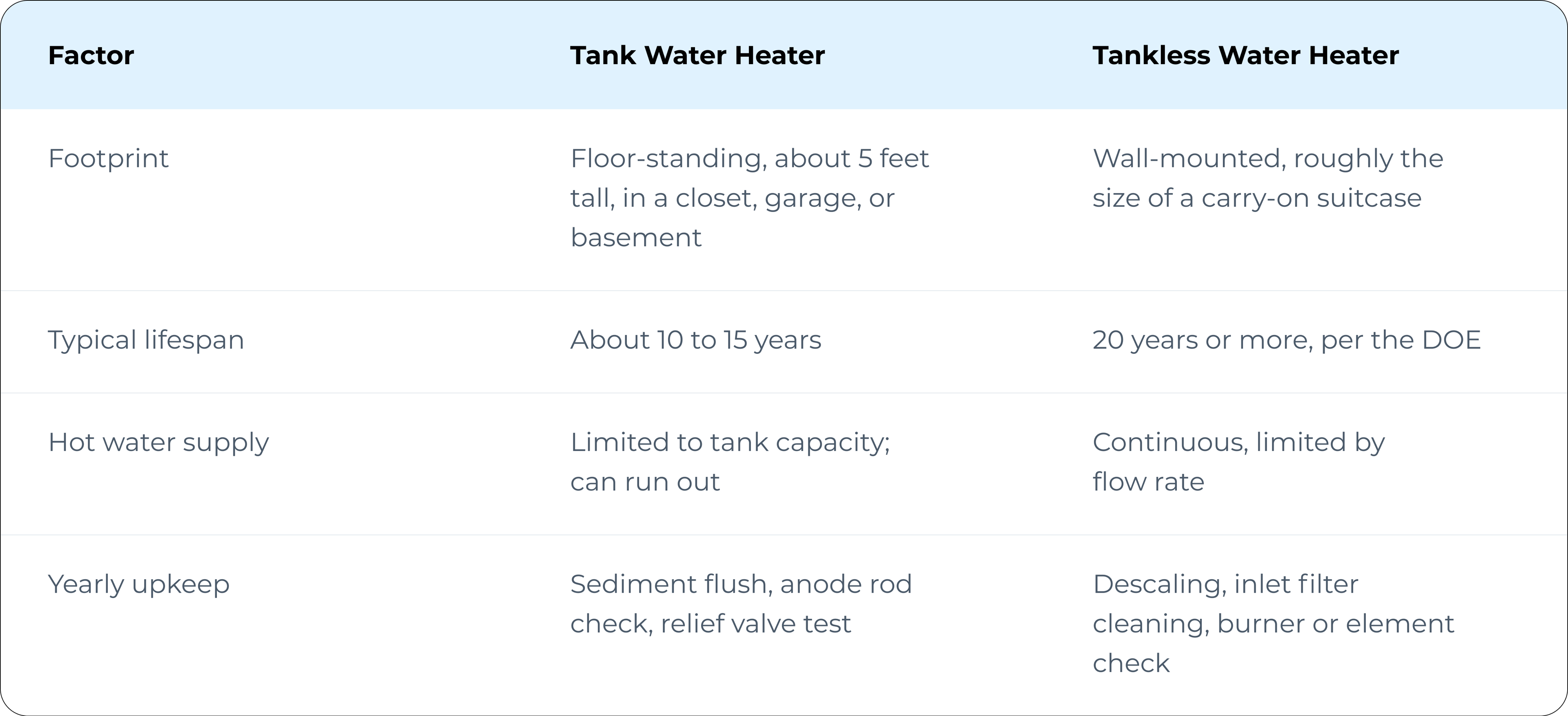
Mineral buildup is the main threat to both systems, so our technicians flush tanks and descale tankless units during routine service. If you ever service a water heater yourself, shut off power at the breaker (or turn the gas valve to “off”), let the water cool completely, and make sure a working carbon monoxide detector is nearby.
Which Water Heater Is Right for Your Household?
The right water heater depends on your family size, daily hot water demand, and how long you plan to stay in your home.
- Small households (1 to 3 people): Tankless often makes the most sense, since lower-use homes see the biggest efficiency gain.
- Larger families (4 or more people): Two showers plus the washer can exceed one tankless unit's flow rate, so a larger tank or a properly sized tankless system fits better.
- Moving within 5 years: A tank keeps upfront costs down, since tankless savings build over time.
- Staying 10 years or longer: Tankless lifespan and lower operating costs add up in your favor.
Get Honest Water Heater Advice From Air Control Heating and Air
Choosing between tank and tankless is a long-term decision, so it should rest on your family, your home, and your budget. Air Control (GA License #CN007762) helps homeowners from Roswell and Alpharetta to Woodstock and Canton find the right fit. We size every recommendation to your actual hot water use, recommend a repair over a water heater replacement whenever that's the honest call, and never try to upsell you.
Connect with us to talk through your tank vs tankless options. Explore Water Heater Services.
 Industry Insights
How to Prepare Your HVAC System for Changing Seasons
 Air Conditioning
What to Look For In a New Air Conditioning System?
 Air Conditioning
Getting Your Home Ready for the Cooling Season